
Learn
Babywearing guide
Everything you need to know about carrying your baby safely and comfortably — from the first week home to the toddler years.
Why babywearing matters
Babywearing isn’t a trend — it’s one of the oldest parenting practices in human history. Cultures across every continent have carried their babies close for millennia, and modern research confirms what parents have always known instinctively: closeness matters.
Carrying your baby regulates their body temperature, heart rate, and breathing patterns. It promotes bonding through skin proximity and rhythmic movement. It supports healthy hip development when done in the ergonomic M-position. And, quite practically, it gives you your hands back.
Research published in Pediatrics found that babies who are carried cry up to 43% less than those who aren’t. They sleep more easily, feed more readily, and develop a secure attachment that supports emotional and cognitive development well beyond infancy.
When to start
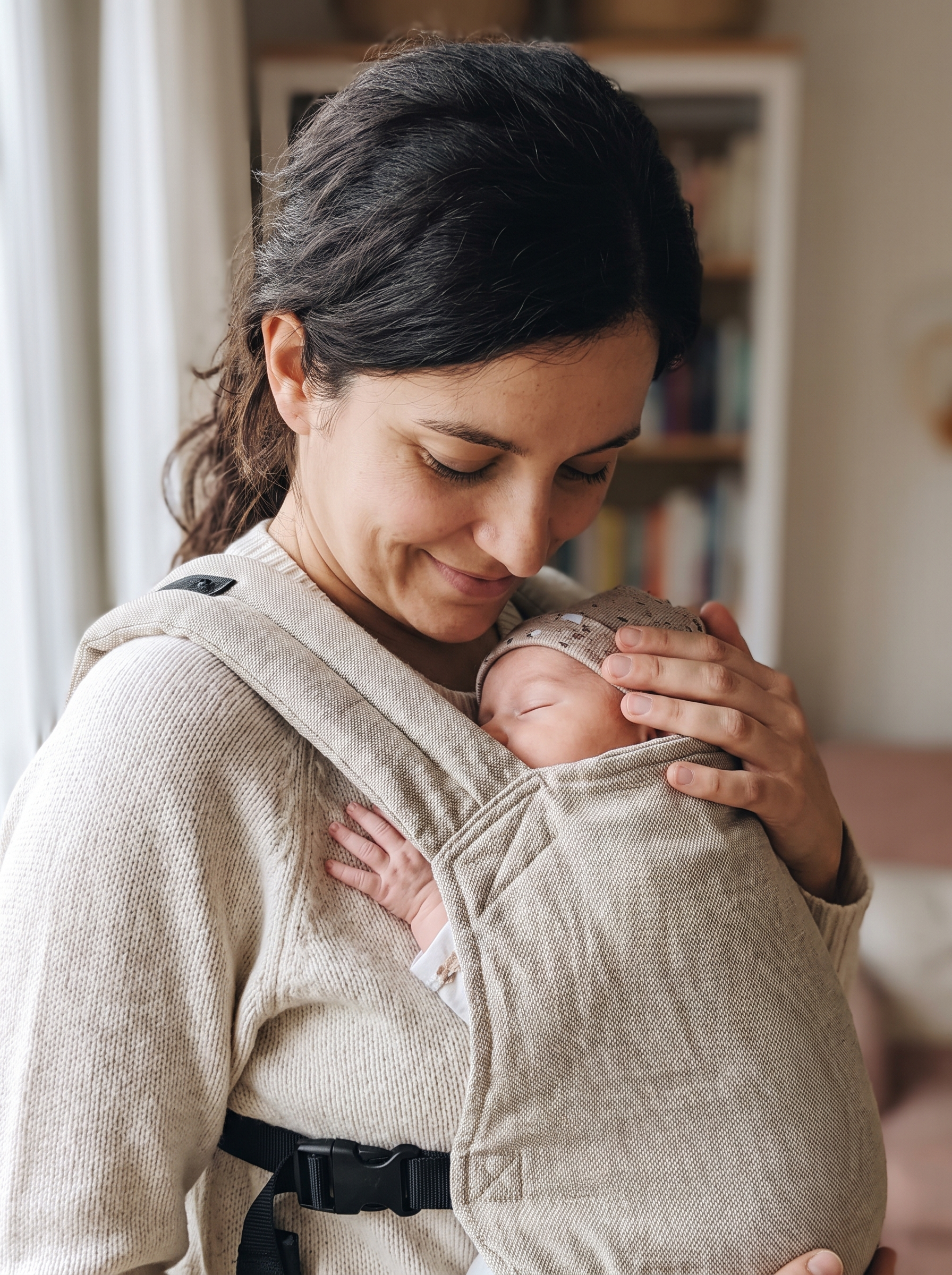
You can begin carrying your baby from day one — provided the carrier supports their weight correctly and keeps them in an ergonomic position. The Née Signature Carrier is designed for newborns from 3.5 kg (7.7 lbs) without any additional inserts.
Key considerations for newborns:
- Always carry facing inward, against your chest
- Ensure their chin is off their chest — you should be able to fit one finger between chin and chest to keep the airway clear
- Their knees should be higher than their bottom, forming the M-position (also called the frog position)
- Support the head and neck until your baby has independent head control (usually around 4–5 months)
- The carrier should be tight enough that your baby doesn’t slump or shift when you lean forward slightly
For premature or low-birth-weight babies, consult your paediatrician before using any carrier.
The T.I.C.K.S. rule for safe babywearing
Follow T.I.C.K.S. every time you carry:
Tight — the carrier should be snug enough that your baby is held close and high. A loose carrier lets them slump, which can restrict breathing.
In view at all times — you should always be able to see your baby’s face by glancing down. No fabric should cover their face.
Close enough to kiss — by leaning your head forward, you should be able to easily kiss the top of your baby’s head.
Keep chin off chest — there should always be a gap (at least one finger width) between your baby’s chin and chest.
Supported back — your baby’s back should be supported in its natural curve. If the carrier is too loose, they’ll slump. If too tight, they’ll arch.
Choosing the right carrier
There are four main types of baby carrier, each with distinct trade-offs:
Wraps — long fabric that you tie around yourself and your baby. Very versatile, excellent for newborns, but the learning curve is steep (5–10 minutes to tie properly) and they can feel overwhelming in hot weather.
Ring slings — a single piece of fabric threaded through two rings. Quick to put on, great for short carries and hip positioning. Less ideal for longer walks as the weight sits on one shoulder.
Soft-structured carriers (SSCs) — what Née makes. A padded waist belt and shoulder straps with buckles. The fastest to put on, most ergonomic weight distribution, and the most versatile across age ranges. The trade-off is usually bulk — though Née addresses this with the fold-into-pouch design.
Meh dais — a hybrid of wrap and SSC, with a structured body panel and fabric ties instead of buckles. Comfortable and adjustable, but slower to put on than an SSC.
Getting the perfect fit
A well-fitted carrier should feel like a comfortable backpack — snug but not restrictive. Most discomfort comes from a carrier that’s too loose (which concentrates weight on your shoulders) or positioned too low (which pulls on your lower back).
The hip belt: This is where 60–70% of your child’s weight should sit. Position it at your natural waist — the narrowest part of your torso, not down on your hip bones. It should be tight enough that you can only slide one flat hand underneath.
Shoulder straps: Should be snug enough that you can’t fit more than two fingers underneath. They keep the carrier close to your body but shouldn’t be bearing the primary load — that’s the hip belt’s job.
The panel: Should support your baby from knee-pit to knee-pit in the M-position. For newborns, narrow the seat width. For toddlers, widen it. The top of the panel should reach the nape of their neck (for babies without head control) or their armpits (for older babies).
The chest strap: Sits at mid-back height (roughly bra-strap level). It prevents the shoulder straps from slipping outward. Snug, not tight.
If something hurts, something’s wrong
A properly fitted carrier should not cause pain — not after 20 minutes, not after two hours. If you feel discomfort, the carrier needs adjusting, not enduring. The most common fixes: tighten the hip belt (takes weight off shoulders), raise the baby higher (reduces lower back strain), and check that the panel is the right width for your child’s size.
Babywearing through the stages
Newborn (0–4 months): Front inward carry only. Focus on the M-position and head support. Keep sessions shorter as you and your baby adjust — 20–30 minutes at first, building up to hours as your confidence grows. This is the peak bonding period; skin-to-skin carrying is especially beneficial.
Infant (4–6 months): Still primarily front carry, but your baby will start looking around more actively. Ensure the panel supports them to the base of their ears until they have full head control. You can start loosening the panel slightly to give them more visual freedom.
Sitting baby (6–12 months): This is when the carrier really comes into its own. You can now introduce hip carry and back carry. Most babies love the hip position at this stage — it matches their growing curiosity about the world. Back carry is excellent for longer outings.
Toddler (12 months – 4 years): Back carry becomes the most practical and comfortable position. Your toddler can see over your shoulder, and the weight distribution is most efficient on your back. The carrier also becomes your secret weapon for overtired toddlers who refuse the stroller.
Babywearing in different situations
Hot weather: Use a carrier with natural, breathable fabric (like Née’s cotton-linen blend). Dress your baby in one fewer layer than you’d wear yourself. Stay hydrated and check your baby’s temperature by feeling the back of their neck — it should feel warm, not hot or sweaty.
Cold weather: Layer your baby normally and wear them inside your coat if possible (babywearing coat extensions are available). Avoid bulky snowsuits inside the carrier — they can compress and affect the ergonomic position.
Cooking: Front carry only, and only on the stovetop’s far side. Never carry while frying or handling boiling liquids. Back carry is safer for kitchen work, but use your judgment.
Hiking: Back carry is ideal. Ensure the carrier is fully tightened and bring sun protection for your child. A carrier with good hip support (like Née) makes a dramatic difference over long distances.
Travel: Carriers are your best friend at airports. They collapse into a bag for security screening, and they’re far more practical than a stroller in an aeroplane aisle. Most airlines allow babywearing during boarding and taxiing.
Ready to start carrying?
See our carrier guide for step-by-step instructions with the Née Signature Carrier.
Shop the collection